More than 2 travelers? Ask for a group proposal.
The Camino de Le Puy, also known as the Via Podiensis, is the oldest and most popular of the French Camino de Santiago routes. Its origins date back to the late 10th century, when Godescalc, the bishop of Le Puy, embarked on a pilgrimage to the tomb of Saint James, accompanied by a large entourage.
Over the centuries, thousands of pilgrims, mainly from France, Switzerland, Germany, Austria, Poland, and Hungary, followed this route, which passed through the Marian cathedral of Le Puy. The monuments, pilgrim hospitals, and legends that have been preserved along the way stand as a testament to its splendor during the Middle Ages.
The Camino de Le Puy ends in Saint-Jean-Pied-de-Port, which is the starting point of the Camino Francés.
The Camino de Le Puy is significantly affected by climatic variations, especially in the stages through the Massif Central, where altitudes exceed 1,000 meters (Margueride, Aubrac). The continental climate can be harsh in spring, autumn, and even summer, so warm clothing and rain protection are essential year-round. Walking this section in winter, between Le Puy and the Lot Valley, is not recommended for those without experience in icy and snowy conditions, often combined with strong winds.
Photo of Goetz Jean Pierre on Unsplash
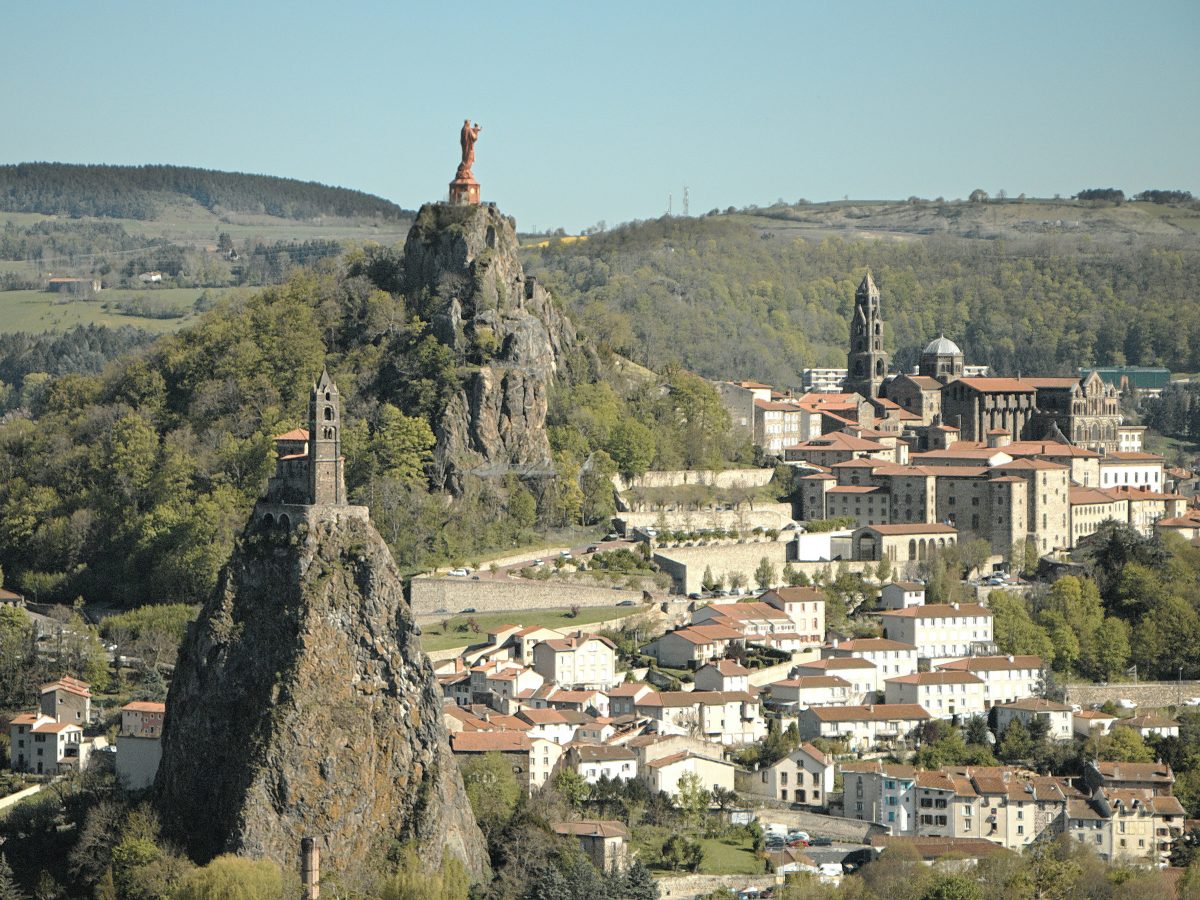
Le Puy-en-Velay is a charming town in the Auvergne region of France, rich in history and natural beauty. One of the town’s most iconic landmarks is the Notre-Dame du Puy Cathedral, a UNESCO World Heritage site. This stunning Romanesque cathedral, perched on a volcanic hill, has been a place of pilgrimage for centuries. Visitors can marvel at its intricate architecture, including the beautiful 12th-century sculptures, and enjoy breathtaking views of the surrounding area from the top of the hill.
Another must-see is the Chapel of Saint-Michel d'Aiguilhe, which sits atop a dramatic 85-meter-high volcanic rock formation. To reach the chapel, visitors must climb 268 steps, but the reward is worth the effort—spectacular panoramic views of the town and its surrounding landscapes. The chapel itself, built in the 10th century, is a remarkable example of medieval architecture.
For those interested in the town’s history, the Musée Crozatier offers a fascinating collection of art and archaeological artifacts, including pieces from the prehistoric, Roman, and medieval periods. The museum also highlights the local history of Le Puy-en-Velay and its role in the pilgrimage route to Santiago de Compostela.
Lastly, Le Puy-en-Velay is surrounded by stunning natural landscapes. The Gorges de l'Allier offer excellent opportunities for hiking and exploring, while the town itself is a great starting point for the Camino de Santiago. Whether you are a history enthusiast, an art lover, or simply someone who enjoys nature, Le Puy-en-Velay has something for everyone.
The journey from Le Puy-en-Velay to Saint-Privat-d'Allier is the first leg of the Camino de Santiago along the Vía Podiensis, a route that takes us through some of the most stunning landscapes in the Auvergne region. Departing from the iconic Notre-Dame du Puy Cathedral, we begin our journey through the beautiful town of Le Puy-en-Velay, passing through winding streets and lush green hills. The path soon leaves the town and enters the countryside, with scenic views of volcanic hills and rocky outcrops, characteristic of the region.
Along the way, we pass through forests, small rural villages, and fields, with occasional glimpses of the town’s distinctive volcanic architecture in the distance. The trail is well-marked with the familiar yellow arrows, guiding us across the gently rolling hills and the occasional climb up to higher points where the views become more expansive.
One notable feature of this section is the Mont Anis, a small hill that provides a beautiful panoramic view of the surrounding countryside. The path is mostly rural and peaceful, with very few distractions, allowing us to reflect on our journey and enjoy the tranquility of nature. The landscape is marked by the characteristic volcanic rock formations and the lush greenery of the Allier Valley.
Upon arrival at Saint-Privat-d'Allier, we are greeted by a small but welcoming village nestled in the mountains. The village is known for its quaint stone houses and its medieval church, Église Saint-Privat, where we can take a moment to rest and reflect. Saint-Privat-d'Allier is a perfect place to rest and recharge before moving on to the next stage of the Camino.
The journey from Saint-Privat-d'Allier to Saugues continues through the rolling hills and forests of the Allier Valley, offering us a peaceful and immersive experience in the natural beauty of the region. This stretch of the route is characterized by its difficulty, with steep climbs and very few places to rest. It’s important to stock up on supplies before starting the stage.
We leave Saint-Privat-d'Allier and walk through vast fields and farmland, with occasional views of the surrounding mountain ranges. The landscape is dominated by volcanic rock formations and lush greenery, typical of the Massif Central. The route also passes through small rural villages and hamlets, where we can find a moment of respite and enjoy the calm atmosphere of the French countryside.
As we approach Saugues, we begin to notice the landscape becoming slightly more rugged, with higher peaks and deep valleys. Saugues, a small town with a rich history, is known for its medieval heritage and its connection to the pilgrimage. The town is a significant stop along the Vía Podiensis, offering us a chance to rest, explore the surroundings, and enjoy the charming atmosphere.
It also has several restaurants where we can enjoy traditional French cuisine, and the town is a great place to interact with other travelers and share experiences.
The stretch from Saugues to Les Faux is a scenic and moderately challenging segment. Leaving the medieval town of Saugues, the trail ascends through peaceful forests and rolling hills, offering expansive views of the Margeride Mountains. This portion is well-marked and combines dirt paths with occasional paved roads.
As we leave Saugues behind, the path gradually climbs into the high plateaus of the Gévaudan region, a land once feared for the legendary Beast of Gévaudan in the 18th century. The landscape is rural and sparsely populated, dotted with small hamlets and ancient stone crosses that have guided pilgrims for centuries. The sense of solitude and connection with nature is profound in this segment.
The village of Chanaleilles, one of the few stops along the way, offers basic services and a chance to rest. Pilgrims often encounter herds of cattle and local shepherds as they cross open fields and meadows. The terrain is gently undulating, but the altitude and remoteness can make it feel more demanding than it appears on paper.
Finally, the route descends slightly to reach Les Faux, a quiet hamlet that welcomes us with modest accommodations and a peaceful atmosphere. It is a fitting end to a day's walk filled with natural beauty, historical resonance, and the deep rhythm of the pilgrimage tradition.
The stage from Les Faux to Aumont-Aubrac offers a scenic and moderately challenging walk through the southern part of the Massif Central in France. The trail gently descends and ascends through rolling hills, forests, and meadows, making it a pleasant journey for both seasoned pilgrims and casual hikers.
Leaving Les Faux, the trail passes through lush greenery and rural farmland. Hikers often encounter traditional stone farmhouses, grazing cattle, and quiet pastures, offering a sense of peace and immersion in the countryside of the Lozère region. The path is typically well-marked with the familiar red-and-white GR 65 signs, and there are occasional opportunities to rest or enjoy a picnic along the way.
As the route progresses, it crosses several small streams and occasionally opens up to panoramic views of the Aubrac plateau in the distance. The natural beauty of the area is striking, especially during spring and summer when wildflowers bloom across the fields. We may also come across chapels or historical markers, reminders of the religious and cultural heritage of the Camino.
The final stretch into Aumont-Aubrac is particularly rewarding. Aumont-Aubrac is a charming and historic village, known as an important stop for pilgrims. With its stone houses, Romanesque church, and welcoming atmosphere, it provides both spiritual and physical rest. The village offers various restaurants and pilgrim services, making it an ideal place to pause and reflect before continuing on the Way.
Aumont-Aubrac, located in the Lozère department of southern France, is a picturesque village and a significant stop along the Via Podiensis, one of the main routes of the Camino de Santiago. Rich in history and tradition, the village offers visitors a blend of religious heritage, rustic charm, and natural beauty.
One of the key landmarks in Aumont-Aubrac is the Church of Saint-Étienne, a Romanesque church dating back to the 11th century. Built with volcanic stone, the church is notable for its simplicity and historical atmosphere. Inside, we can admire ancient stonework, religious sculptures, and a peaceful setting that invites reflection. It has long served as a spiritual haven for pilgrims walking the Camino.
Another point of interest is the statue of the Beast of Gévaudan, a legendary creature that terrorized the region in the 18th century. The statue, located in the village center, commemorates this infamous part of local folklore. Aumont-Aubrac takes pride in its connection to this mystery, and the story adds a mythical layer to the area’s cultural identity.
Strolling through the old town, we will find well-preserved stone houses, narrow lanes, and several small shops selling local cheeses, charcuterie, and crafts. The village has retained much of its medieval character, and walking through its streets offers a step back in time. The main square is a lovely place to relax, enjoy a coffee, and observe the calm rhythm of village life.
Aumont-Aubrac is also a gateway to the Aubrac plateau, known for its vast open landscapes, wildflowers, and traditional buronnières (stone huts used in cheese-making). Nature lovers and hikers will appreciate the trails and natural vistas accessible from the village, making it a perfect starting point for exploring the broader region.
The “from” price is for one traveler. When travelers share a room, the booking total is adjusted automatically.
| Travelers | Adjustment to booking total |
|---|---|
| 2 travelers sharing | −540,00€ from the booking total |


